Orbital Memory
An immersive light sculpture and atmospheric fiction
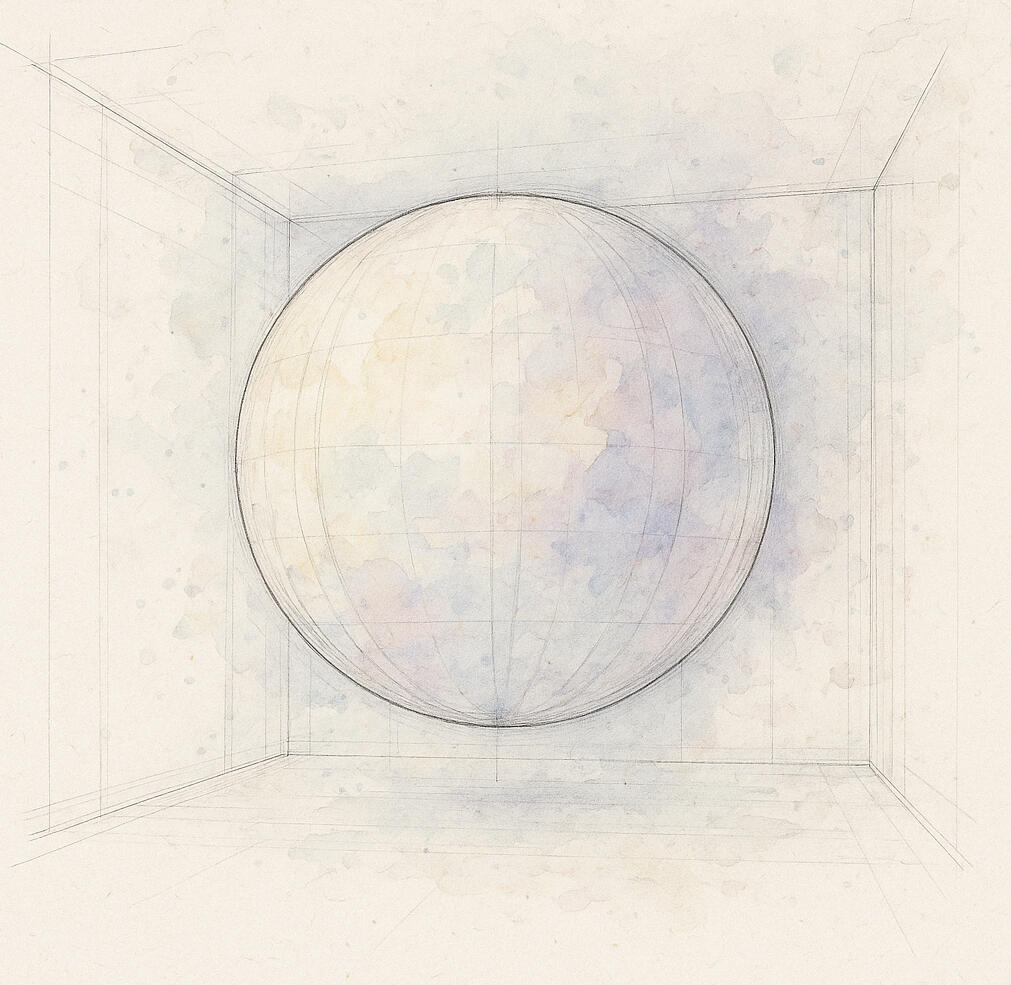
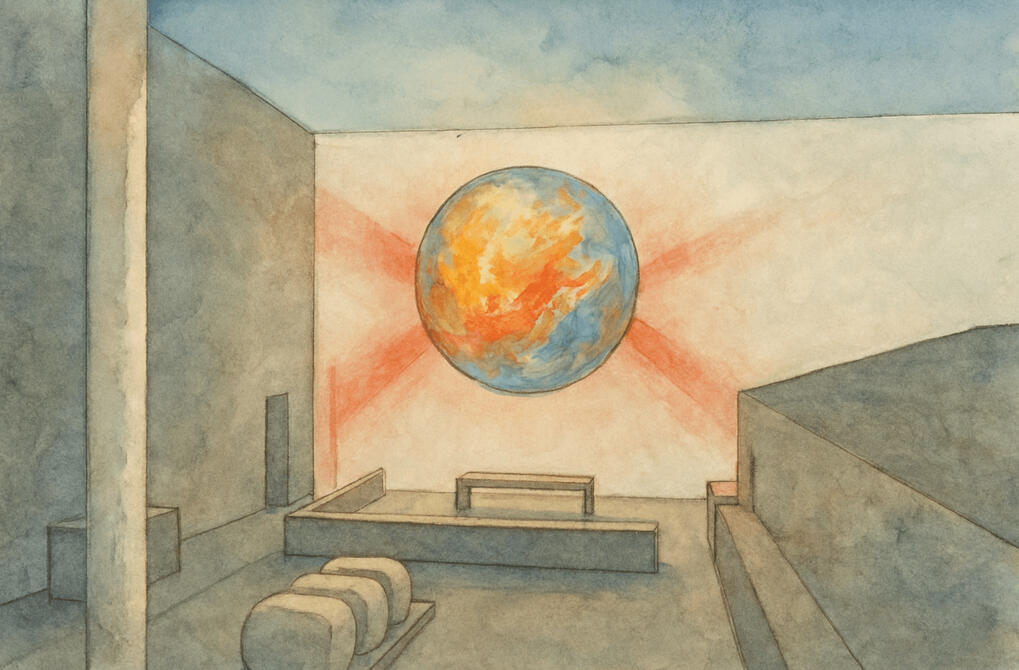
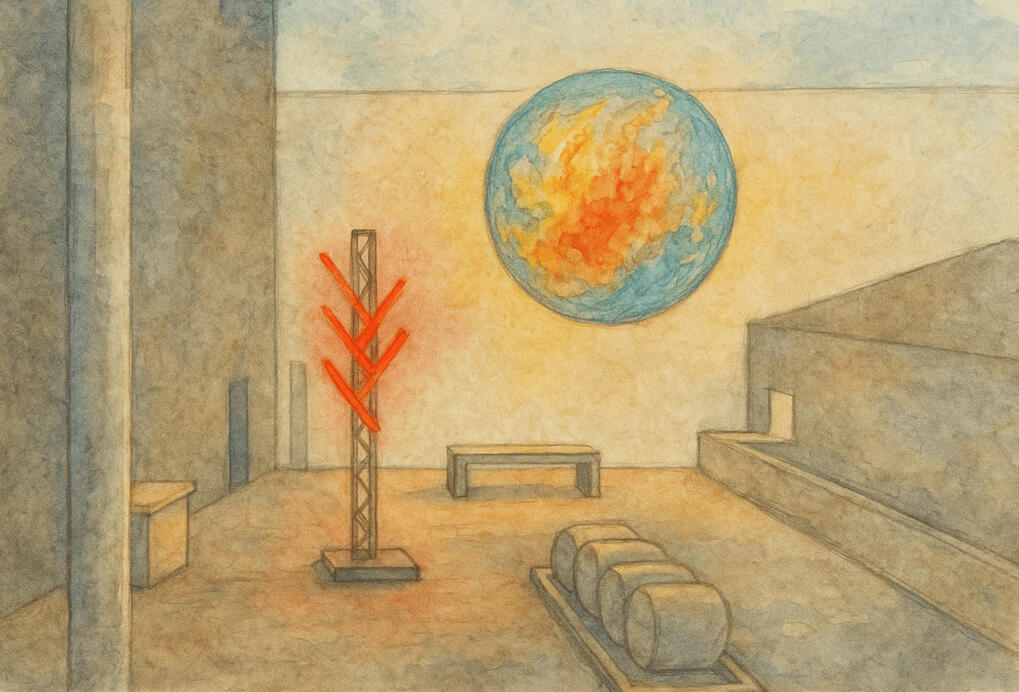
"Orbital Memory" is a suspended light installation centered around a monumental 9-foot meteorological balloon — a relic of climate science reimagined as an instrument of emotional weather.
Once used to measure the atmosphere, the balloon is now repurposed as a luminous archive, floating weightless and waiting. Its surface becomes a canvas for shifting visual narratives — an interplay of light, motion, and abstraction. The projected content suggests not only data, but memory: dissolving maps, spectral signals, soft codes, and imaginary topographies. As light pulses and flows across its volume, the sphere takes on a presence — like a celestial body caught between states, always watching, never speaking.
This work lives in the in-between: between sculpture and cinema, science and poetry, signal and myth. It evokes a future where instruments built to monitor the sky begin to dream. It invites viewers to drift with it — not as observers, but as participants in its quiet orbit. Light is the language. The surface is not passive, but reactive, like a new kind of skin or weather system.
"Orbital Memory" explores themes of presence, surveillance, ecological fragility, and digital mysticism. It suggests that light can be both data and emotion — a way to visualize what can't be spoken, or to feel what cannot be measured.
Minimal in structure yet vast in implication, the installation invites audiences to slow down, look up, and inhabit a kind of meditative fiction. It asks: What do we trust more — what we see, what we measure, or what we feel?
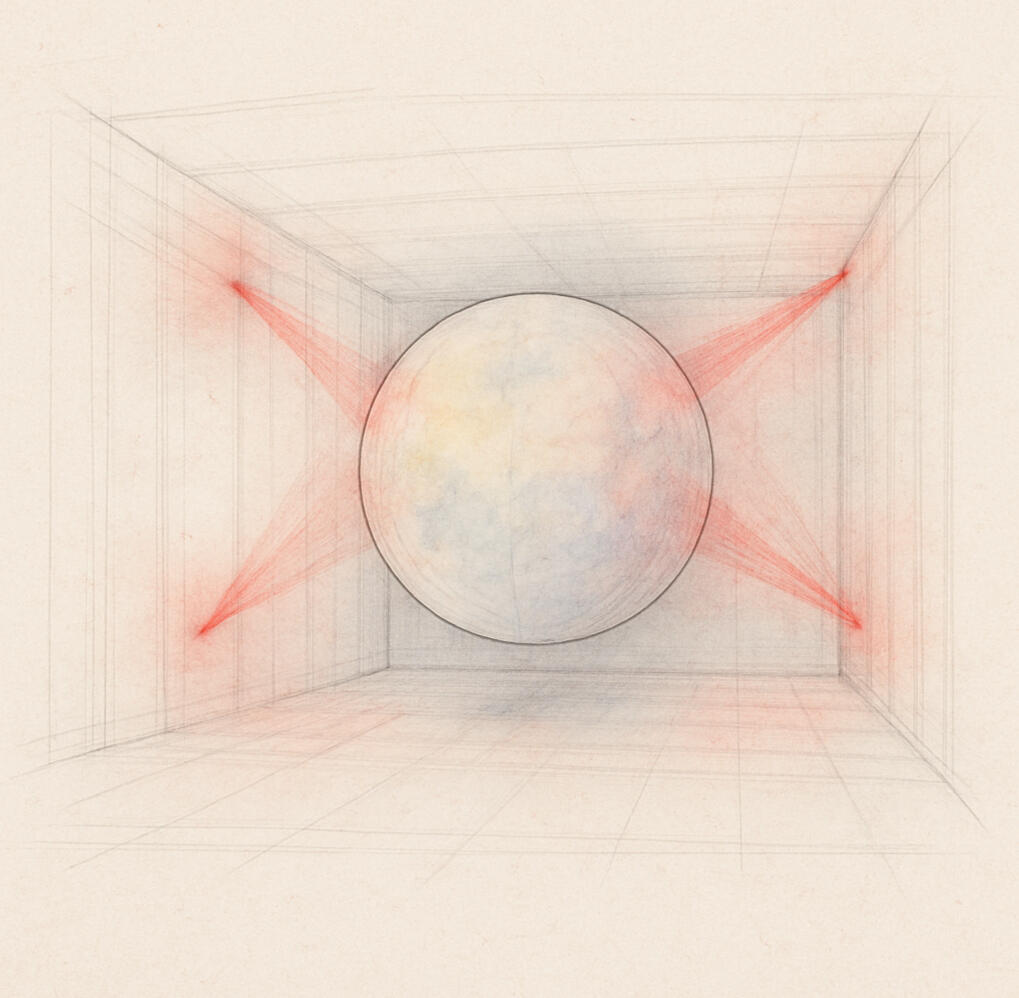
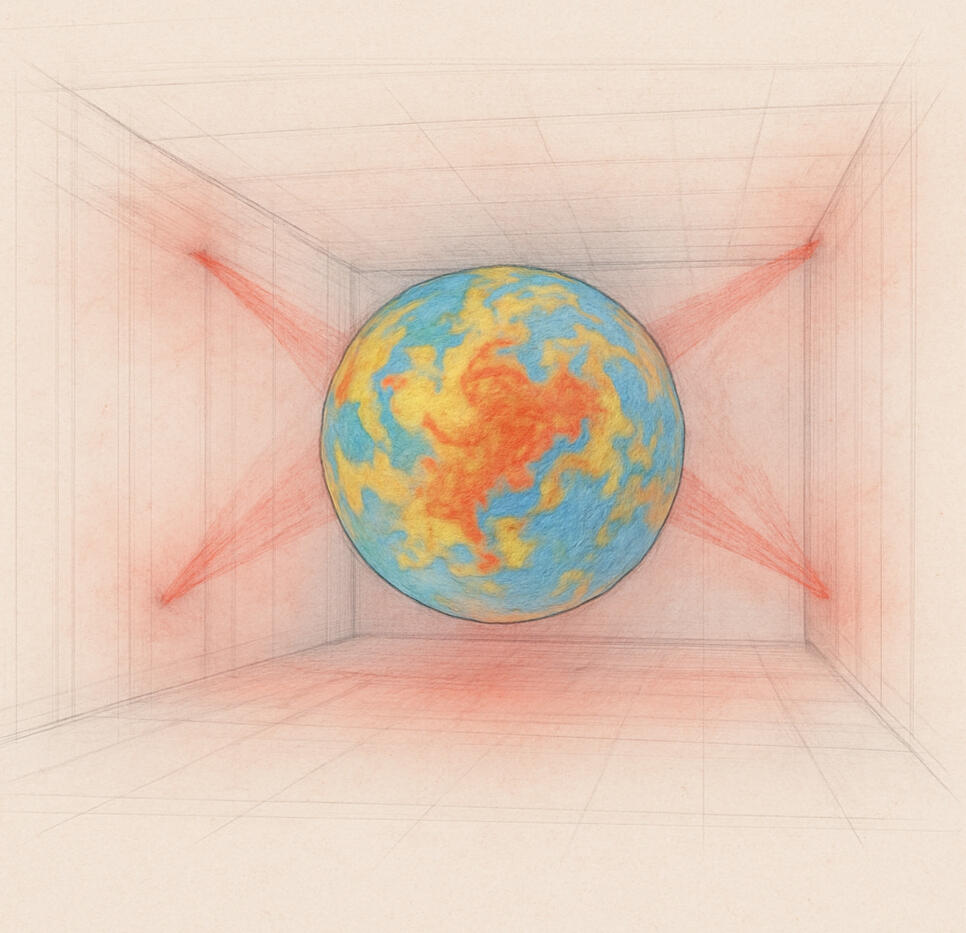
Both DMX lights and projector lighting the sphere.
Walking into the venue, we were immediately confronted with a maze of obstacles. Making the idea of mounting the projector directly overhead almost impossible. Each attempt to find a clear path was thwarted by obstructions, forcing us to rethink what “perfect projection” really meant. Add to that the anxiety of balancing on ladders while holding expensive equipment—we were testing both our nerves and our patience.
After multiple failed attempts, we settled on a compromise: a waist-height stand for the projector, angled precisely to cover the sphere. We tucked it behind barrels and a palm tree. It wasn’t elegant, but it worked, giving us enough room to adjust angles freely and keep the visuals uninterrupted. This solution reminded us that creativity often thrives under constraint.
The sphere itself presented another challenge. Hanging an 8-ft inflatable latex orb from a 14-foot cord drilled securely into the walls required careful planning and teamwork. From the moment it hovered in the air, it became a running joke among the crew for looking like a giant piñata. By the end of the night, the prospect of taking it down was daunting. Venue staff were insistent—everything needed to be cleared immediately. But after hours of intense setup, dismantling it with care was out of the question. So, we gently poked it and let it slowly deflate, a strangely satisfying ritual that marked the end of the event as if the installation itself were exhaling.
Meanwhile, the VIP section offered its own narrative twist. Initially, it felt empty, divided from the general entrance by a simple barrier. Guests ignored it, and it seemed pointless. But once someone discovered that VIP access granted direct entry to the DJ booth, everything changed. Within minutes, the space transformed into a hub of energy, filled with dancers letting loose. The lesson was clear: exclusivity, when tied to a unique experience, can completely alter audience dynamics.
Lighting was another story. Thanks to Sebas’s ingenuity, we managed to erect two vertical truss towers configured like trees. Each “branch” of the trusses held Astera Bar Lights, strategically positioned to create depth and movement across the venue. For the first time, we dedicated significant energy to programming sequences. Slow ambient fades gave way to synchronized color sweeps, white strobe bursts built tension, and carefully timed blackouts created dramatic resets. Watching the audience react to the interplay of lights and visuals was incredibly rewarding—it felt like the venue itself was breathing with the show.
The Astera Bar Lights, familiar and quick to rig, proved that even equipment we’ve used for years can feel fresh and spectacular when paired with thoughtful planning. The programming elevated the show, turning functional lighting into a choreographed visual narrative. From start to finish, every moment felt intentional, every effect a calculated move to engage, surprise, and immerse the audience.
Looking back, there are a few things we’d do differently. Multi-projector setups would make the sphere projections more volumetric, adding a sense of 3D depth that a single projector could not achieve. Planning teardown logistics more thoroughly would also help us close the night with less stress. Yet, despite these challenges, the installation was a success. It was complicated, intense, and exhausting—but undeniably magical.
The technical backbone of the event held everything together. The 8-ft white latex sphere, mounted on wall anchors and inflated with a standard air pump, became the central canvas. The NEC PA622U projector,
throwing 6,200 lumens from roughly 49 feet, delivered crisp visuals directly from a laptop running the DNA Film Project content. Sixteen Astera Bar Lights, controlled wirelessly via DMX, added dynamic energy with programmed sequences synced to the music. All of this was orchestrated by our team, led by Pulpul Guzman, ensuring that design, rigging, projection mapping, and lighting worked as a single, cohesive show.
The night ended with the sphere gently deflating, VIP dancers exhausted but elated, and lights gradually dimming—a perfect exhale after hours of creative intensity. The installation had challenged us physically, technically, and creatively, but it had also rewarded us with an experience that felt immersive, cinematic, and alive. It was a reminder that, in live art, the journey of problem-solving, improvisation, and collaboration can be just as compelling as the final spectacle itself.
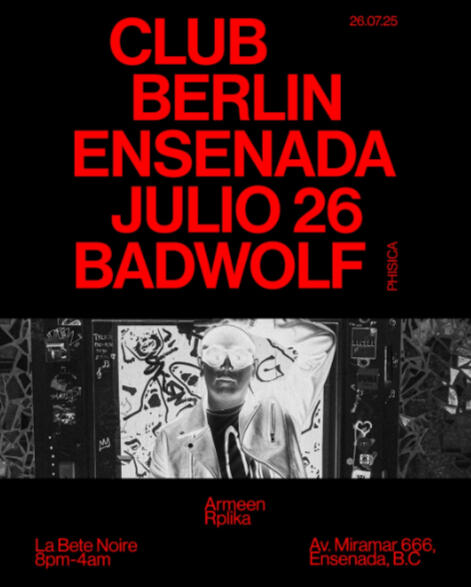
we will have more archive footage soon...
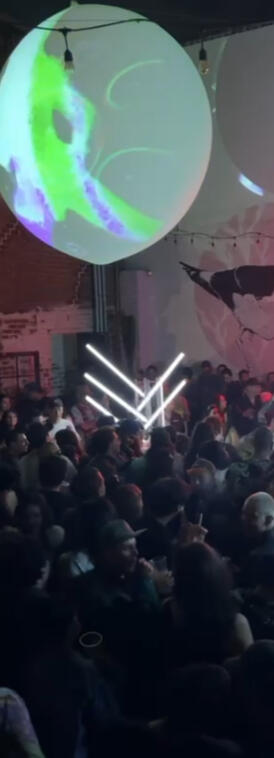
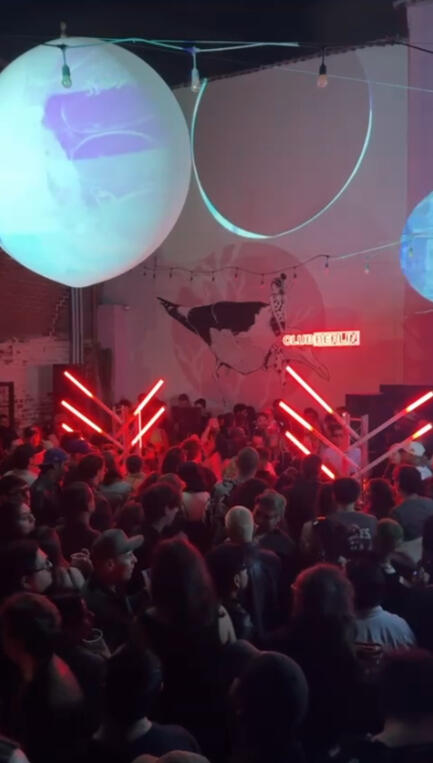
the first time we used the balloons, we actually used two.